Compost Kitchen Waste
Summary: Compost at Home
Description
Composting in Newburyport is Important!
Why compost?
“One of our most significant challenges for society and our community is disposing of the ever-increasing volume of waste of all forms. As you may be aware, organic waste from the production of foods, as well as, from our tables and kitchens is adding to the weight of our trash and disposal costs. Composting this organic waste not only reduces costs but also reduces methane emissions and enhances soils, water retention and provides carbon sequestration. We thank the current residents who are already composting and encourage all others to review our guide to composting and decide to participate in the "COMPOST for a Healthier Newburyport" program in the way that works best for you and your family.” Molly Ettenborough, Recycling and Energy Manager, Newburyport
Please find Newburyport's complete guide to composting here.
How can I compost in Newburyport? There are at least three ways (others can be found online).
a. CURBSIDE PICK UP SERVICE
We have partnered with Black Earth Compost to provide a pick up serice. They offer two self-pay subscriptions: (1) $11.99/mo for weekly pick up, or (2) $8.99/mo for pick up every other week.
To sign up, please contact Black Earth Compost. Telephone: 978-290-4610; email- blackearthcompost@gmail.com or on their webbsite https://blackearthcompost.com/
Currently over 900 Newburyport households subscribe to Black Earth’s curbside composting service. Most people use a 13- gallon latched bin (13" w x 13" l x 27" h) with locking lid and wheels available from Black Earth for $29.50 and also purchase biodegradable bag inserts. Many find a second 3-gallon size kitchen countertop container convenient. A benefit of this program is you have the option of receiving a free bag of Black Earth compost annually for your garden.
View Black Earth Compost's How to Compost video here.
b. BACKYARD
The Earth Machine is a durable backyard compost bin designed to compost food and yard waste. It will produce an all-natural soil conditioner, which provides gardens with much needed nutrients, while helping to retain moisture in the soil. Typically, it has an 80-gallon storage capacity, has a twist locking lid and is easy to maintain. Of course, it produces larger amounts of compost material for your garden. Earth Machines may be purchased by residents of Newburyport at the Yard Waste Facility at a subsidized rate.
c. FREE DROP-OFF
A third composting option is similar to option (a.) except that instead of curbside pickup, when your compost container is full, you can drop its contents off at a free compost collection bin located at 115 Water Street, the Newburyport Wastewater Treatment Facility.
Deep Dive
U.S. Food Waste Facts
- Food waste is estimated to be 30–40% of the food supply. (U.S. Food and Drug Administration)
- According to the World Wildlife Federation, the production of wasted food is equivalent to the greenhouse emissions of 37 million cars. (RTS)
- Food “waste” is the single largest category of material municipal landfills, where it emits methane, a powerful greenhouse gas (GHG). Such solid-waste landfills are the third-largest source of human-related methane emissions in the U.S., accounting for approximately 14.1% of these emissions in 2017. (U.S. Department of Agriculture)
- Food waste is a huge climate issue in the U.S. because, when it is placed in landfills, the anaerobic conditions cause its decomposition to generate methane, a potent GHG. By composting, we return this organic matter to the natural carbon cycle.
- Although home composting does not solve our national food-waste dilemma, it is an important step down a better path. Community-wide composting can make an even greater impact. Nature’s capacity for carbon drawdown is extraordinary, and returning food waste to the soil is a significant part of the equation. This is an action that most of us can take together, each in our own household, to increase the health of the soil and of the climate!
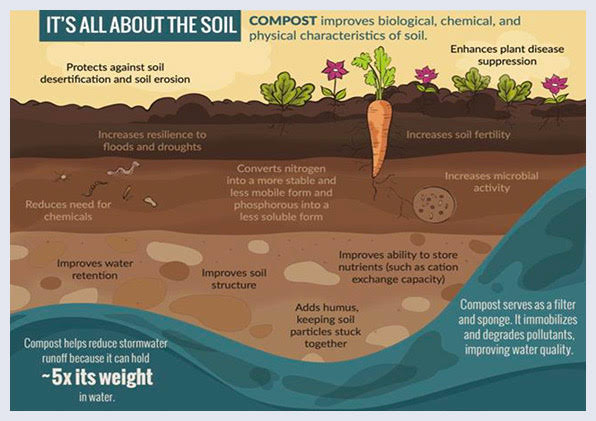
- Healthy soil provides additional benefits, as the illustration below demonstrates. (Thanks to the Mothers Out Front Massachusetts Healthy Soils group for the graphic.)
- It is estimated that for each ton of compost produced and used, one-half ton of CO2 can be sequestered in healthy soil. (BioCycle)
- For every four households that adopt composting sequester a half ton of carbon annually.
- Every 1% increase in soil organic matter — thus, soil carbon content — adds 1.4 acre-inches (approximately 38,000 gallons) of water-holding capacity.” (Healthy Soils and The Climate Connection)
Steps to Take
- For CURBSIDE PICK UP SERVICE:
- Contact Black Earth Compost: Please call 978-290-4610 or email- blackearthcompost@gmail.com or go to their website https://blackearthcompost.com/
- For BACKYARD composting:
- Purchase a durable backyard compost bin designed to compost food and yard waste. One brand is the Earth Machine which can be purchased by residents of Newburyport at the Yard Waste Facility at a subsidized rate.
- For FREE DROP-OFF
- Purchase a compost bin and biodegradable bag inserts and when your compost container is full, drop its contents off at a free compost collection bin located at 115 Water Street, the Newburyport Wastewater Treatment Facility.
Resources
Pro tip for sourcing your non-digital reading: support a local bookstore, check out a copy from your library, or start your own environmentally themed book exchange to share and borrow books from neighbors, friends, and family.
Composting at Home, U.S. Environmental Protection Agency
Books:
Let It Rot! The Gardener's Guide to Composting, by Stu Campbell (an adult resource)
Compost: A Family Guide to Making Soil from Scraps, by Ben Raskin (a kid-friendly book on composting)
Compost Stew: An A to Z Recipe for the Earth, by Mary McKenna and Ashley Wolff (a fun rhyming book for younger kids)
Articles & Documentaries (courtesy of Black Earth Compost)
19-Year Study Shows We've Been Undervaluing How Much Compost Can Boost Carbon Capture, Science Alert
Can Dirt Save the Earth, The New York Times Magazine (on storing carbon in the soil) Global Warming’s Dirty Little Secret, The [Manchester] Cricket
Wasted! The Story of Food Waste, documentary available on YouTube
Kiss The Ground, documentary available on Netflix
Only 60 Years of Farming Left If Soil Degradation Continues, Scientific American
Compost Transport: City To Farm (a statewide compost allocation network shows promise), BioCycle
Compost and Mulch Utilization on California Almond Farm (farm saved money, increased yield, improved soil health, reduced water and pesticide use), BioCycle
- All Actions